Most parenting plans are written for cooperative coparents. They contain warm language about flexibility, mutual decision-making, "the best interests of the child," and good-faith communication. For two reasonable adults, this kind of plan works fine — because the plan rarely has to be enforced.
For high-conflict cases, this kind of plan is a disaster.
Every gap, every ambiguity, every appeal to mutual cooperation becomes an opportunity for the high-conflict parent to extract concessions, manufacture disputes, or rewrite the rules in real time. The plan becomes a starting point for negotiations rather than the binding document it was meant to be.
This article walks through what a parenting plan needs to look like in high-conflict cases, what specific clauses to push for, and how to write a document that holds up when one parent is determined to test it.
Note: This is general guidance, not legal advice. Specific provisions vary by jurisdiction. Work with a family law attorney experienced in high-conflict cases when drafting or modifying any court order.
The principle: specificity is protection
If there is a single guiding principle for high-conflict parenting plans, it's this: specificity is protection.
Every undefined term, every vague phrase, every "the parties shall mutually agree" clause is a potential battleground. The high-conflict parent will exploit ambiguity. They will read the plan in whatever way benefits them. They will claim ambiguous provisions mean what they want them to mean.
The remedy is to write the plan so that a complete stranger could enforce it without input from either parent. If there's nothing left to interpret, there's nothing left to fight about.
This makes parenting plans for high-conflict cases longer, more detailed, and more contractual-sounding than typical plans. That's not a defect. It's the design.
Schedule provisions
The schedule is the heart of the plan. Get it wrong, and you'll be in court regularly. Get it right, and most disputes simply can't arise.
Specific exchange times and locations
Don't write "exchanges shall occur after school." Write "the receiving parent shall pick up the children from [specific school name] at the regular dismissal time of [time]." Don't write "exchanges happen at the parents' homes." Write "exchanges shall occur at [specific neutral location] at [specific time]."
What happens if the receiving parent is late
"If the receiving parent has not arrived within 30 minutes of the scheduled exchange time, the sending parent shall retain the children for that day, and the receiving parent's next scheduled time shall begin as originally scheduled." This eliminates the "I was just running late" manipulation of an entire day of parenting time.
Detailed holiday rotation
Spell out every holiday, every year, for the foreseeable future. Christmas Eve, Christmas Day, Thanksgiving, Easter, Mother's Day, Father's Day, each child's birthday, each parent's birthday, and any culturally significant holidays. Specify start times and end times. Specify who has which holiday in even-numbered years versus odd-numbered years.
Summer schedule
Whether the regular school-year schedule continues, or whether summer follows a different rotation. If summer differs, specify start and end dates. Specify how vacation weeks are selected and what notice is required.
Vacation provisions
How much advance notice is required for vacations. Whether the other parent must be informed of itinerary, contact information, and lodging. Whether out-of-state travel requires anything special. Whether out-of-country travel requires written consent.
What "first right of refusal" means — if anything
"First right of refusal" clauses (one parent must offer the other parenting time before using a third-party caregiver) sound great in cooperative cases. In high-conflict cases, they're often a tool of manipulation — used to monitor and control the other parent's life. If included, define narrowly: time threshold (typically 24+ hours), notification method, response window.
Communication provisions
Communication clauses do enormous work in high-conflict plans. They define what's allowed, what's required, and what's forbidden.
Designated communication channel
"All communication between the parents regarding the children shall occur through [specific coparenting app or designated email address]." This concentrates the record, prevents text-message disputes about what was said, and produces court-admissible logs.
Limited subject matter
"Communications shall be limited to matters directly affecting the children, including: schedule, education, medical care, and significant child-related expenses." This excludes the relationship-processing, emotional venting, and personal attacks that fill high-conflict communication.
Response time requirements
"Each parent shall respond to communications regarding non-emergency matters within 48 hours, and to emergencies within a reasonable time." Without this, the high-conflict parent can use silence as control. With this, you have an enforceable standard.
Communication with the children during the other parent's time
"Each parent may have one phone or video call with the children per day during the other parent's parenting time, at a time agreed in advance, of no more than 15 minutes' duration." This prevents the constant interrupting calls that some high-conflict parents use to disrupt their ex's time with the kids.
What's prohibited
Plans can prohibit specific behaviors: discussing the other parent or the litigation with the children, using children as messengers, recording children for litigation purposes, posting about the children on social media, introducing new romantic partners to the children before a defined milestone. These prohibitions are enforceable.
Decision-making provisions
The default in many jurisdictions is "joint legal custody" — both parents must agree on major decisions. In high-conflict cases, this default is often a disaster. It guarantees that every decision becomes a negotiation, which becomes a fight, which becomes a court motion.
Better alternatives:
Tie-breaking authority
Both parents must consult, but one parent has final decision-making authority if they cannot agree. Authority can be assigned by domain — one parent has tie-breaking on medical, the other on educational, etc.
Domain assignment
One parent has full authority over certain domains (medical, educational, religious, extracurricular). The other parent must be informed but does not have decision-making authority.
Status quo provisions
"Until otherwise agreed in writing or modified by the court, the children shall continue to attend [current school] / receive medical care from [current provider] / etc." This prevents one parent from unilaterally changing the children's circumstances.
What constitutes a "major decision"
Define this. Courts often default to "education, religion, and non-emergency medical care." For high-conflict cases, you may want to expand: counseling/therapy, extracurricular activities exceeding a cost threshold, body modifications, social media accounts, dating, driver's licenses, employment.
Dispute resolution provisions
What happens when the parents disagree? Without a clear process, every disagreement becomes a court motion. With one, most disagreements get resolved out of court.
Required mediation or co-parenting facilitation before court
In some jurisdictions, you can require parents to attempt mediation or use a parenting coordinator before filing motions. This filters out the frivolous motions and forces direct engagement on real disputes. In severe cases (DV histories, etc.), this provision should be carefully crafted or omitted, since mediation can be unsafe.
Allocation of court costs
"In any motion brought to enforce this order, the prevailing party shall be entitled to recover reasonable attorney's fees and costs from the non-prevailing party." This deters frivolous filings — if you bring a motion you can't win, you pay for both sides' lawyers.
Right to seek emergency relief
Despite mediation requirements, some matters require immediate court action. Preserve the right to seek emergency relief without first going through ADR.
Behavior and conduct provisions
Some plans include specific provisions about parental conduct:
- Neither parent shall consume alcohol or non-prescribed substances during their parenting time.
- Neither parent shall expose the children to romantic partners overnight unless the relationship has been established for [X months/years].
- Neither parent shall make disparaging comments about the other parent in the children's presence or hearing.
- Neither parent shall use the children as messengers or interrogate them about the other parent's home.
- Neither parent shall record the children for litigation purposes without informing the other parent.
These are enforceable. Violation can support contempt findings or modifications.
For specific high-risk situations
Different high-conflict situations call for additional provisions.
Active addiction concerns
Required testing protocols (Soberlink, hair follicle, random urinalysis). Specific consequences for failed or missed tests. Supervised exchange protocols. Defined process for resuming unsupervised parenting time. Built-in escalation triggers.
Domestic violence histories
No direct contact at exchanges. Use of supervised exchange centers or third-party intermediaries. No-contact provisions where appropriate. Distance restrictions. Enhanced documentation requirements. Clear emergency protocols.
Suspected alienation
Required reunification therapy with specific provider qualifications. Make-up time provisions for missed visits. Specific anti-disparagement clauses. Requirements for the other parent to actively encourage the children's relationship with you.
Mental health concerns
Required treatment provisions where appropriate. Medication compliance requirements. Therapeutic visitation. Process for resuming standard parenting time.
The clauses to fight hardest for
If you can only push for a few specific provisions, prioritize these:
- Designated written communication channel — this single provision changes everything about the day-to-day reality of high-conflict coparenting.
- Tie-breaking authority on medical/educational decisions — eliminates the perpetual negotiation that joint legal custody creates.
- Detailed schedule with specific times and locations — closes the manipulation loopholes.
- Defined consequences for late exchanges — removes the incentive for chronic lateness.
- Attorney's fees provision — deters frivolous filings.
- Anti-disparagement and no-children-as-messengers clauses — protects the children directly.
Working with your attorney
An attorney who's done high-conflict cases will understand all of this. An attorney who hasn't may push back on the specificity, telling you that detailed plans are "rigid" or "make things harder." Insist anyway, or find a different attorney.
Bring your attorney specific examples of what your coparent does. The more concrete you can be about the manipulation patterns you're trying to head off, the better the attorney can craft provisions to address them.
And remember: the plan you negotiate today is the plan you live with for years. Time spent getting it right at drafting saves multiples of that time spent in court later.
A note on perfectionism
No plan is bulletproof. A determined high-conflict parent will find ways to test even the best-drafted order. The goal isn't a plan that prevents all manipulation — it's a plan that massively reduces the surface area for manipulation, gives you clear standing to enforce when it happens, and produces the contemporaneous record that supports modifications down the road if needed.
You're not trying to write a plan that eliminates conflict. You're trying to write a plan that makes conflict expensive, slow, and unproductive for the parent inclined to engage in it — while making your normal life predictable and protected.
That's an achievable goal. And it's worth pursuing aggressively.
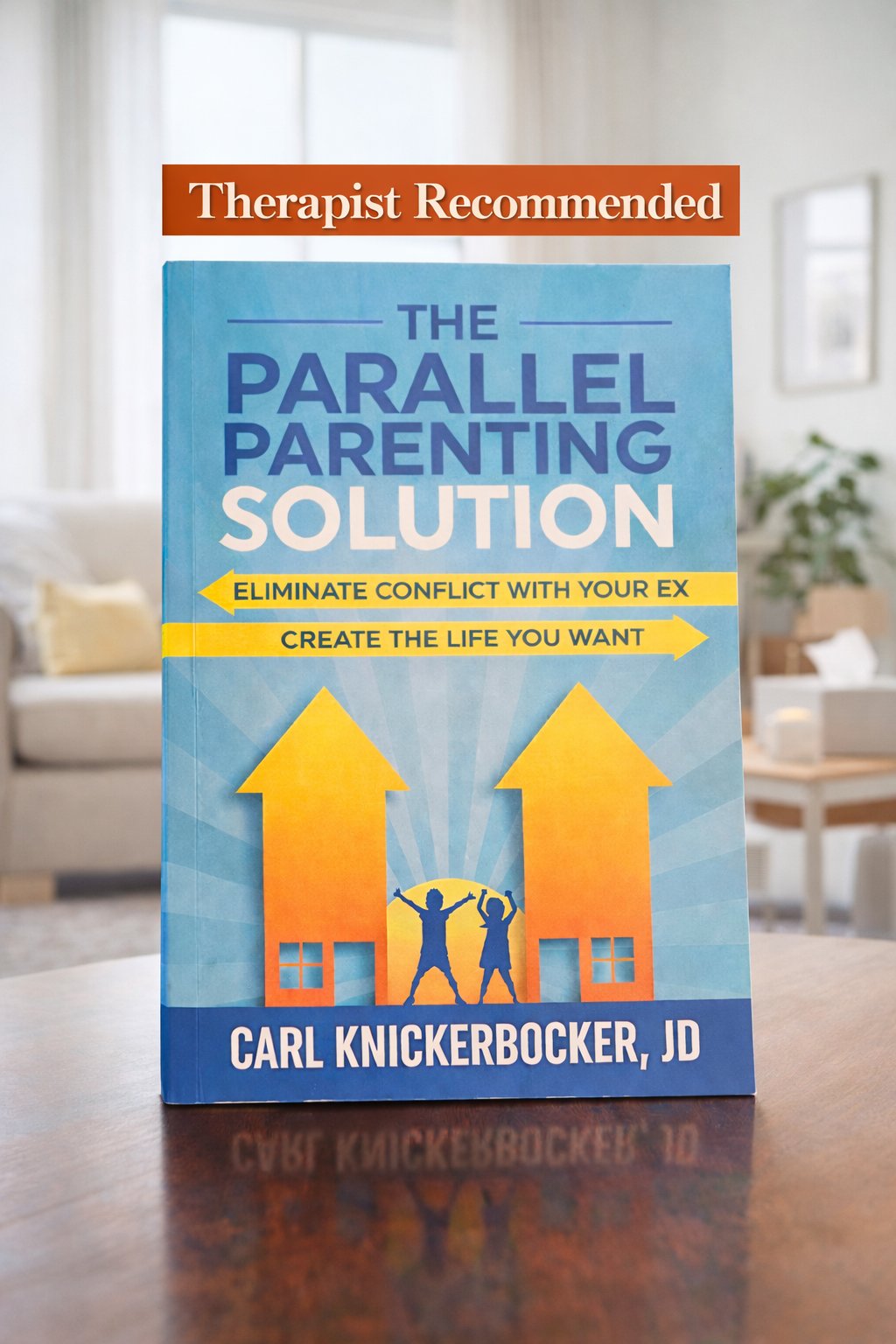
The complete legal strategy.
This article draws on both The Parallel Parenting Solution and Family Court Solutions. The books include sample language, case examples, and the strategic framework for working with your attorney to build the strongest possible case.
Get the Book