If you survived an abusive relationship and now share children with the person who abused you, almost everything mainstream coparenting advice tells you is wrong for your situation.
"Communicate openly." "Be flexible." "Put aside your differences for the kids." "Try to maintain a friendly relationship." Each of these instructions assumes you are dealing with someone safe to negotiate with. You are not. The advice that works for amicable divorces can be actively dangerous in a context where one party is willing to use coercion, manipulation, or violence.
This article is for survivors. It walks through why you need a different framework, what protective coparenting looks like in practice, and how the principles of parallel parenting can be applied (with modifications) to situations involving abuse histories.
If you are in immediate danger, this article is not the resource you need. Call 911, or contact the National Domestic Violence Hotline at 1-800-799-7233 (TTY 1-800-787-3224). For online support, visit thehotline.org.
Why standard coparenting advice fails survivors
Mainstream coparenting frameworks rest on a foundational assumption: both parties want what's best for the children, and both will negotiate in good faith. Disagreements happen, but they're disagreements between two parents who care more about the children than about winning.
Abusers do not operate this way. Abuse, at its core, is about control. Coparenting with someone whose pattern is coercive control means every interaction is potentially another instance of control — even after the relationship ends. The legal system sometimes provides tools for control. The schedule is a tool for control. The children themselves can become tools for control.
When mainstream coparenting advice tells survivors to "communicate openly," it's recommending more contact with the person whose contact has been the source of harm. When it tells survivors to be "flexible" with the schedule, it's recommending the survivor cede control over their and their children's lives to the person who has misused control. When it tells survivors to "set aside differences," it's recommending they minimize what was done to them.
None of this serves the children. None of it serves the survivor. And in some cases, it puts both at significant risk.
What protective coparenting looks like
Protective coparenting — sometimes called "parallel parenting with safety provisions" — is built on a different set of assumptions:
- The other parent has demonstrated patterns of harmful behavior.
- Reducing contact reduces opportunity for harm.
- What contact must occur should be structured, documented, and protected.
- The children's safety and the survivor's safety are not in tension; both matter, both are achievable.
- The legal system is an imperfect tool, but it's a tool the survivor can use.
The practical implementation looks different from standard parallel parenting in several specific ways.
Communication: written only, third-party platform
For survivors, written-only communication isn't just a preference — it's a safety measure. It eliminates the opportunity for verbal abuse, manipulation through tone, threats that can later be denied, and the disorienting confusion that survivors of coercive control often experience after direct contact.
The standard recommendation: communicate exclusively through a court-monitored platform like OurFamilyWizard, TalkingParents, or AppClose. These platforms timestamp every message, prevent editing, log read-status, and produce court-admissible records.
If the abuser refuses to use the platform, document that refusal. If the platform is required by court order and the abuser violates it, document that. The pattern of refusal becomes evidence.
Communication should be:
- Limited strictly to logistics involving the children
- Brief, factual, and free of emotional content
- Free of any reference to the relationship, the abuse history, or anything personal
- Saved permanently
If you find yourself drafting a long emotional message — even a justified one — don't send it. The platform isn't a place to process. It's a place to handle logistics.
Exchanges: structured, public, witnessed
Exchanges are the highest-risk moments in protective coparenting. They are also the most fixable through good planning.
The progression of safer exchange options, from least to most protective:
Public neutral location. A police station parking lot, a fast food restaurant with cameras, a busy public area. Witnesses present. Recordings (if visible cameras) inherent in the location.
School or daycare exchange. One parent drops off; the other picks up. Parents never see each other. The school staff become inadvertent witnesses to the schedule being followed (or not followed).
Third-party intermediary. A trusted family member, friend, or paid professional facilitates the exchange. Reduces direct contact while still requiring presence.
Supervised exchange center. Many counties operate supervised exchange centers specifically designed for high-risk situations. Parents arrive at staggered times, exchange children through trained staff, and never encounter each other. Records are kept.
Supervised visitation. If the children's safety with the other parent is at risk, courts can order that visits themselves be supervised by a trained third party. This is a major intervention but appropriate in serious cases.
Whatever level your situation calls for, build it into the court order. Make the protective structure formal. The more it lives in writing, the harder it is for the other party to chip away at.
The schedule: rigid, predictable, enforced
Standard parallel parenting recommends detailed schedules. Protective parallel parenting requires them.
The schedule should leave nothing to discussion: pickup times, drop-off times, locations, exchange protocols, what happens if the other parent is late, what happens if they fail to appear, what happens during holidays, what happens for vacations.
Refuse to negotiate ad hoc changes. "The schedule stands" should become a reflex. Every time you allow a deviation "just this once," you teach the other party that the schedule is negotiable, which gives them a tool of control. The few legitimate cases where flexibility might genuinely serve the children are not worth the cost of opening the door.
Decision-making: court-defined, no real-time negotiation
The parenting plan should specify exactly which parent has decision-making authority over which domains. Joint legal custody — where both parents must agree on major decisions — is often weaponized in coercive control situations. Every decision becomes a venue for control. Every disagreement becomes an opportunity to refuse, delay, or extract concessions.
For survivors, single decision-making authority over critical domains (medical, educational, religious) is often safer and more protective. It eliminates the negotiation that the other parent uses as a tool.
If sole decision-making isn't achievable, tie-breaking authority is the next best thing — both parents must consult, but if they cannot agree, one parent has the final call.
Documentation is non-negotiable
For survivors, documentation isn't just useful — it's essential. The patterns that prove abuse, the violations of the order, the manipulations of the schedule, the harassment that breaks through the rules — none of these can be addressed in court without records.
Document everything:
- Every communication, saved and backed up
- Every schedule deviation, with dates and times
- Every late pickup, missed visit, or no-show
- Children's emotional state at exchanges
- Anything the children spontaneously share that suggests problems at the other home
- Any direct contact attempts that violate the protocol
- Any third-party reports — from teachers, doctors, family
If protective orders are in place, document every violation, however small. Patterns matter.
Recognize the post-separation tactics
Abuse often shifts form after separation. The physical violence may end (or it may not), but coercive control frequently continues through other channels:
Litigation abuse. Filing endless motions, requesting endless modifications, generating endless legal fees. The court system becomes the new venue for control.
Financial abuse. Refusing to pay child support, hiding income, manipulating shared expenses, requesting modifications to reduce obligations.
Children as weapons. Using parenting time as leverage. Withholding the children. Coaching the children to report concerns. Making false allegations through the children.
Allegation reversal. Accusing the survivor of abuse, alienation, instability, or whatever else might shift the legal narrative.
Surveillance. Monitoring the survivor's social media, asking children about the survivor's life, showing up at events, keeping tabs through mutual contacts.
Stalking. In severe cases, direct stalking behaviors continue post-separation.
None of these are "high-conflict coparenting" in the ordinary sense. They are continuations of the abuse, in a form adapted to the post-separation reality. Recognizing them as such is important — both for your own clarity and for the legal arguments you may need to make.
Working with the right professionals
Not all family law attorneys are equipped for DV cases. Look specifically for attorneys who:
- Have specific experience representing survivors
- Understand coercive control as a concept (not just physical violence)
- Are familiar with the local resources — DV shelters, supervised exchange centers, qualified evaluators
- Will push for protective provisions in orders without minimizing your concerns
Same for therapists. A general therapist may inadvertently encourage you back into contact patterns that are unsafe. A therapist trained specifically in DV recovery will understand the dynamics and support protective decisions.
For the children: trauma-informed therapists are essential. Avoid generalists. Children who have witnessed or experienced abuse need specialized support.
The hardest part: when the legal system fails you
It would be dishonest to write this article without acknowledging that family courts often fail DV survivors.
Allegations may not be believed. Evaluators may not be trained in DV dynamics. Judges may default to "both parents matter" assumptions that miss the reality. Custody may be awarded to abusers. Protective parents may be punished for raising safety concerns.
This is not your fault. It is not because you didn't document well enough or didn't fight hard enough. It is a systemic failure that affects many survivors, and it is something organizations and advocates are actively working to change.
If this happens to you, know that:
- Your story is not unique. There are communities of survivors who understand exactly what you're experiencing.
- Continued documentation matters. Patterns become more visible over time.
- Modifications are possible. As children age, as evidence accumulates, as new judges hear cases, outcomes can shift.
- Your children are watching how you carry yourself through this. Your example matters more than the immediate outcome.
- You are not alone, and you are not crazy.
The longer view
Protective coparenting after abuse is not about defeating the abuser. It's not about making them be different than they are. It's not even, in many cases, about justice — because justice in this context is often unavailable.
It's about building a safe, stable, loving life for yourself and your children, despite the ongoing presence of someone who has tried to prevent that. It's about minimizing the surface area of harm. It's about staying in your own integrity. It's about being the parent your children can come to as they grow up and start to make sense of what they've witnessed.
The framework laid out in The Parallel Parenting Solution applies here, with the safety modifications described in this article. The goals of disengagement, structure, and self-determination are the same. The execution is more careful, more documented, more legally formalized.
You did not cause this situation. You cannot fix the other person. What you can do is build the safest, most loving life available given the circumstances — and that is not a small thing. It may, in the long run, be the most important thing you ever do.
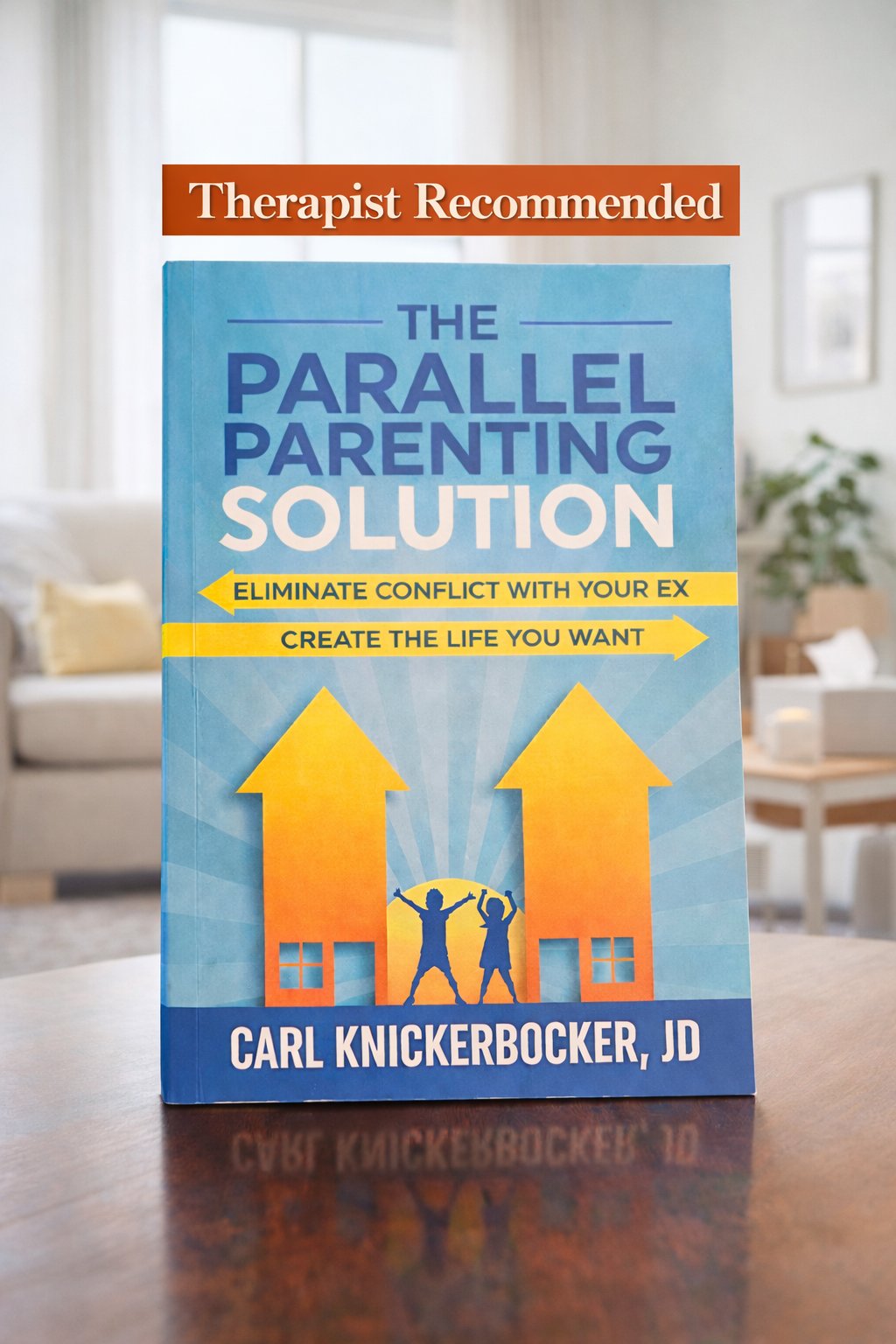
The complete framework, applied with care.
This article adapts the principles of The Parallel Parenting Solution for situations involving abuse histories. The book and its companion Family Court Solutions provide the full framework, with strategies that translate directly to protective coparenting contexts.
Get the Book