Open any mainstream coparenting book and you'll encounter some version of the same instruction: both parents should maintain consistent rules, schedules, expectations, and approaches across both households. Same bedtime. Same screen-time rules. Same approach to homework. Same diet. Same discipline. The "united front" that supposedly serves the child.
This advice is so widespread, so confidently asserted, that questioning it feels almost transgressive. But here's the truth: in high-conflict coparenting situations, this advice is not just impractical — it is harmful, both to you and to your kids.
This article makes the case for the alternative: two genuinely different households, each operating from their parent's actual values, with the children moving between them. Done well, this isn't a compromise — it's a feature.
The "united front" fantasy
The united-front model assumes two parents who fundamentally agree on the major questions of how to raise children, with minor differences smoothed out through good-faith communication. Under those conditions, consistency does serve children — they get a coherent set of expectations, predictable consequences, and the security of knowing their parents are aligned.
But that's not most divorced families. And it definitely isn't the families that arrive at parallel parenting.
The reality for most divorcing couples is that they had genuine disagreements about parenting before the divorce. Often, those disagreements were among the reasons for the divorce. Bedtime fights, screen-time fights, discipline fights, dietary fights, religious fights — these don't get resolved by the act of separating. They just become harder to negotiate, because the structure that made compromise feel necessary (one shared household) is gone.
So when divorced parents try to maintain a "united front," what they're really trying to do is continue negotiating the same parenting disagreements that contributed to the divorce — without the daily proximity, mutual goodwill, or shared logistics that made any of that bearable. It doesn't work. And the consequences cascade.
What happens when you try to enforce sameness
When two parents who don't agree on parenting try to operate as though they do, several things go wrong predictably.
Compromise produces a watered-down version that neither parent actually wants. If you wanted bedtime at 8:30 and your ex wanted bedtime at 9:30, the negotiated 9:00 satisfies neither of you and reflects neither of your actual values. You're now parenting from the lowest common denominator — not the best version of either of your visions, but a pot of bland parenting stew with no flavor.
Each negotiation becomes another opportunity for conflict. Every "we have to agree on this" creates another battlefield. Each disagreement becomes another argument the child overhears or senses. The conflict the divorce was supposed to end becomes a permanent feature of your shared parenting.
You undermine your own parental authority. When you have to constantly justify your decisions to the other parent — and worse, defend them when the other parent contradicts them — your authority in your own home erodes. The child sees that your decisions are subject to outside override.
You expose yourself to ongoing manipulation. If you're committed to consistency, the other parent has constant leverage. They can change a rule on their side and pressure you to follow. They can refuse to enforce something on their side and frame your enforcement as harsh by comparison. Every parenting choice becomes an opening for negotiation, criticism, or attack.
The kids learn that their parents fight about everything. Even when the fights are conducted by email or via lawyers, kids absorb the constant tension. The "united front" actually exposes them to more conflict, not less, because everything has to be negotiated.
The parallel parenting alternative
The parallel parenting model is unambiguous: each home runs by its own rules, set by the parent in that home, without negotiation with the other.
You decide what bedtime is at your house. They decide what bedtime is at theirs. You decide what screen-time rules apply at your house. They decide at theirs. You decide what foods are served, what discipline is used, what activities are encouraged, what chores are required, what religious practices are observed. They decide for their home.
Within reason and within the law, neither parent has authority to dictate the rules of the other's home, and neither parent owes the other an explanation.
This sounds radical to people who've absorbed the united-front gospel. It isn't. It's how every other context in a child's life already works.
Kids already navigate this every day
Consider what's already true about your child's life:
- School has different rules than home. The teacher's rules apply at school. They're different from your rules. Your child handles this without confusion.
- Each grade has different teachers with different expectations. Your child meets these teachers, learns their rules, and adjusts every September without trauma.
- Friends' houses have different rules. When your child sleeps over at a friend's, the friend's parents are in charge. Different bedtimes, different snacks, different rules. Your child manages.
- Grandparents' houses have different rules. Probably much looser ones. Most kids understand intuitively that "Grandma's house is different."
- Camps, daycares, sports teams, religious programs, and after-school activities all have their own rules. Your child absorbs and switches between these contexts constantly.
Children are much better at context-switching than the united-front model gives them credit for. They have to be — they live in a world full of different settings with different expectations, and they manage it as a basic life skill from the time they start preschool.
"Mom's house has these rules, Dad's house has those rules" is genuinely no harder for them than "school has these rules, Grandma's house has those rules."
What kids actually need from divorced parents
Decades of research on children of divorce point consistently to two factors that predict child wellbeing — and neither one is "consistency between households."
The first is low exposure to inter-parental conflict. Kids who watch their parents fight are harmed by it, regardless of whether the fights are about parenting choices, finances, scheduling, or anything else. The single most important thing divorced parents can do for their children is keep the conflict away from them.
The second is warm, engaged, predictable parenting from at least one parent. When at least one parent provides a stable, loving, present home — even if the other parent is chaotic, neglectful, or absent — children show remarkably resilient outcomes.
Notice what's missing from this list: matching bedtimes. Identical screen rules. The same discipline approach. The same dinner menu. None of these things appear in the research as predictors of child wellbeing in divorced families.
What the research actually shows is that fighting about these things harms children, not the differences themselves. Two homes that operate differently and don't fight about it produce better outcomes than two homes that pretend to be the same and fight constantly about it.
What kids learn from witnessing different households
There's actually an upside that the united-front model misses entirely: children learn from observing how different adults make different choices. Each home becomes a laboratory of values.
If you value early bedtimes, healthy meals, limited screen time, and structured weekends — and your home reflects those values consistently — your child learns what a household built on those values looks like. They feel it. They internalize it.
If the other parent's home looks different, the child learns from observing that contrast too. They notice the differences. As they get older, they form their own judgments about which approaches feel better, which ones serve them, which ones they want to take into their own adult lives.
This is, frankly, a richer education than getting the same rules in two homes. Children who grow up watching one parent live their values clearly — and watching another parent live differently — develop an active relationship with the question of how to live. That's a gift.
What this looks like in practice
Some specific examples of what "two different homes" looks like in practice:
You might serve dinner at 6 PM at a set table with the phones away. The other parent might serve dinner at 8 PM in front of the TV with takeout. Don't fight about it. Don't comment on it. Don't make the kids feel guilty about either model. They get to experience both.
You might require homework be done before screens. The other parent might allow screens whenever. Enforce your rules at your house consistently. Don't try to enforce them at theirs.
You might have family dinner be a phone-free conversation. The other parent might run a chaotic household with TVs always on. Your home is your home. Make it the home you want.
You might celebrate certain holidays in particular ways. The other parent might do them differently. Don't try to coordinate. Don't try to compete. Make your celebrations great in your way.
The principle: you are accountable for your home. They are accountable for theirs. You decide what excellence looks like at your house — not the lowest common denominator both households can agree on, but the actual best version of what you can build.
Two important caveats
This framework has limits:
Safety is not negotiable. If the other parent's home involves genuine safety issues — neglect, abuse, dangerous adults, untreated addiction with children present — that's not a "different rules" situation. That's a legal issue and requires legal action. The "two homes" framework applies to differences in lifestyle, not differences in basic child welfare.
Some logistics genuinely require coordination. Medical decisions, school choice, religious upbringing in some cases, and major activities often legally require both parents' agreement. Parallel parenting doesn't mean ignoring legal requirements. It means handling them through formal channels (court orders, written communication, designated decision-making domains), not through ongoing negotiation.
The freedom this gives you
Once you fully accept that your home doesn't have to match the other parent's home, something liberating happens. You stop spending mental energy on what they're doing differently. You stop trying to influence choices that aren't yours to make. You stop measuring your home against theirs.
You start building the home you actually want. The rules that reflect your values. The rituals that mean something to you. The meals you want to share. The activities you want to do. The pace you want to set.
And what you'll likely find is that this version — your authentic, uncompromised version — is the one your children remember. Not as the "right" rules versus the "wrong" rules at the other house, but as your home, the place where things felt the way they did because of who you are.
That's worth more than consistency. That's actually what kids need.
Read the full chapter.
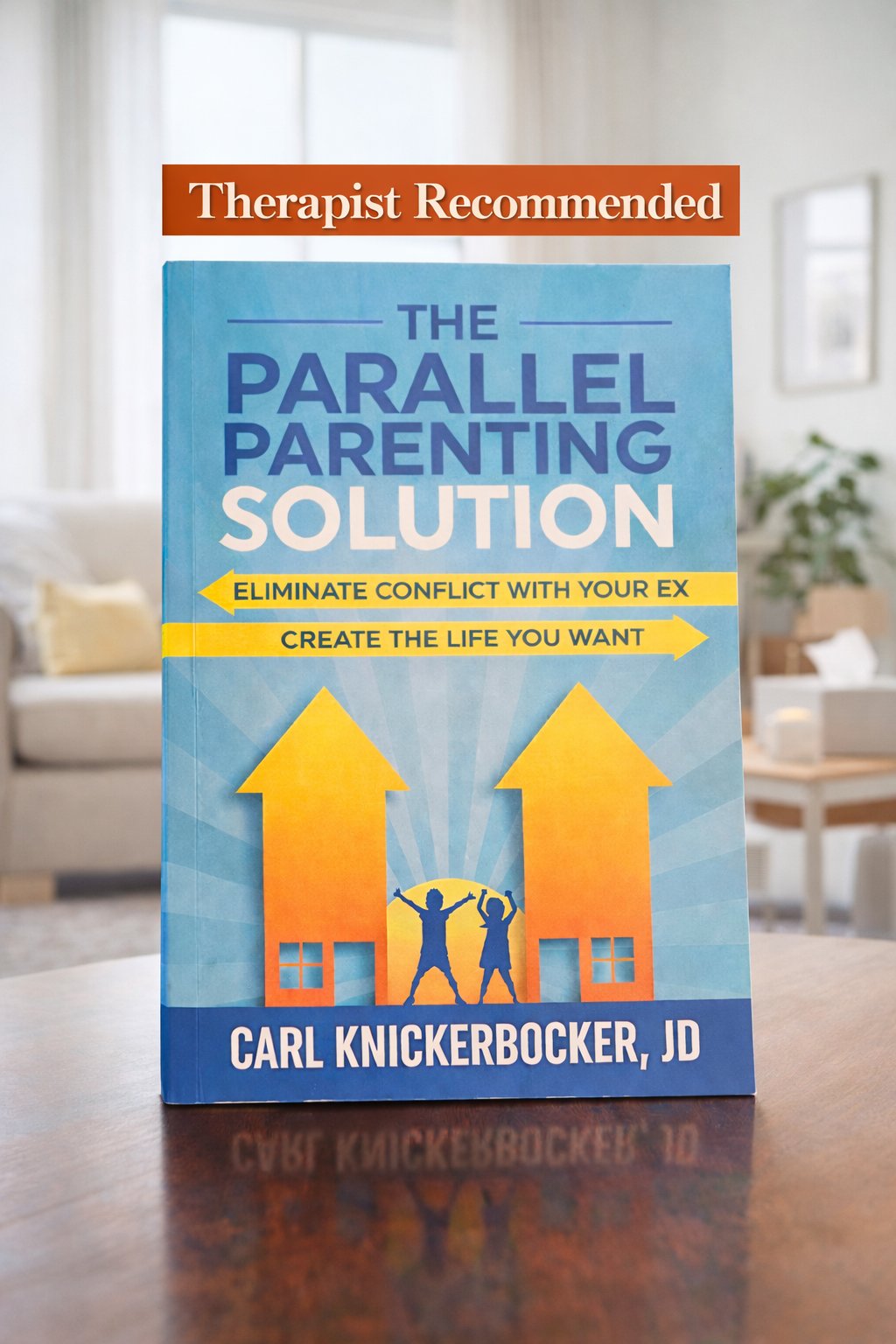
This article is adapted from The Parallel Parenting Solution. The book includes more examples, scripts for specific scenarios, and the complete framework.
Get the Book